Choosing the right structural system is one of the most
important — and often most overlooked — decisions in home construction. It
affects your budget, construction timeline, design flexibility and the
long-term durability of your building. In Bengaluru, RCC (Reinforced Cement
Concrete) remains the most common choice for residential construction, but
steel structures are gaining popularity for specific use cases. Here's how the
two compare.
What Is RCC Construction?
RCC construction uses a combination of concrete and steel
reinforcement bars to form the structural skeleton — columns, beams and slabs —
of a building. It has been the standard method for residential and mid-rise
construction in India for decades.
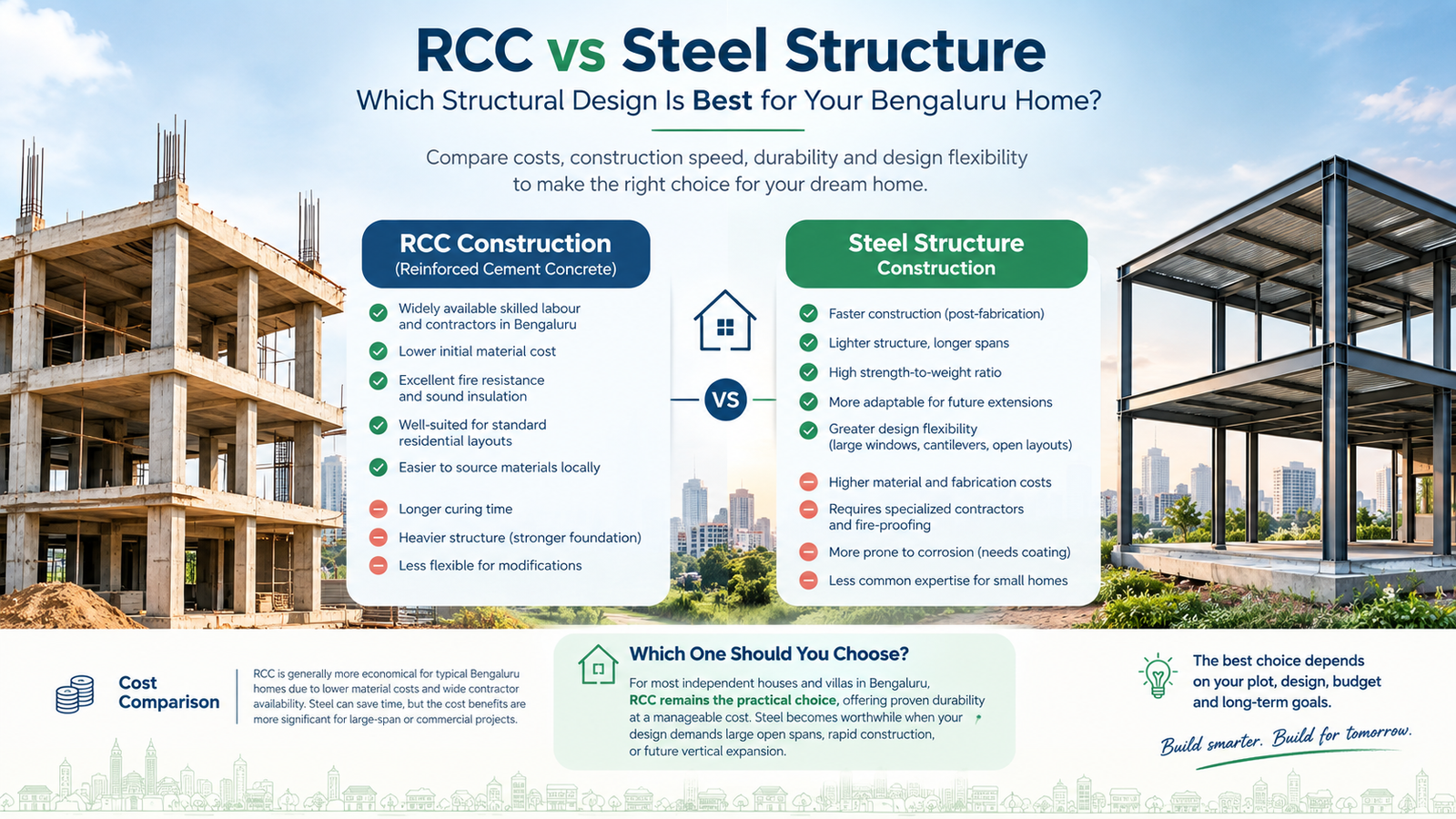
Advantages of RCC:
- Widely
available skilled labour and contractors in Bengaluru - Lower
initial material cost compared to structural steel - Excellent
fire resistance and sound insulation - Well-suited
for standard residential layouts and load conditions - Easier
to source materials locally, reducing supply delays
Limitations of RCC:
- Longer
curing time, which can extend construction schedules - Heavier
structure, requiring stronger foundation design - Less
flexible for later structural modifications
What Is Steel Structure Construction?
Steel structures use fabricated steel sections — columns and
beams — as the primary load-bearing frame, often combined with concrete slabs
or lightweight flooring systems. This method is common in commercial buildings,
warehouses, and increasingly in premium residential and prefabricated homes.
Advantages of Steel Structures:
- Significantly
faster construction once fabrication is complete - Lighter
structure, allowing longer spans and open floor plans - High
strength-to-weight ratio, useful on sites with poor soil conditions - More
adaptable for future extensions or floor additions - Greater
design flexibility for large windows, cantilevers and open layouts
Limitations of Steel:
- Higher
material and fabrication costs in most residential contexts - Requires
specialized contractors and fire-proofing treatment - More
susceptible to corrosion without proper protective coating - Less
commonly available expertise for small residential projects
Cost Comparison: RCC vs Steel
For a typical Bengaluru residential project, RCC generally
works out more economical due to lower material costs and wide contractor
availability. Steel structures can offset their higher material cost through
faster construction timelines, but the savings are usually more significant in
commercial or large-span projects than in standard homes. A detailed cost
estimation comparing both options for your specific plot and design is the only
reliable way to decide.
Which One Should You Choose?
Factor | RCC | Steel |
Best for | Standard residential homes | Large spans, additions, commercial use |
Construction speed | Moderate | Fast (post-fabrication) |
Initial cost | Lower | Higher |
Design flexibility | Moderate | High |
Maintenance | Low | Requires anti-corrosion upkeep |
Local contractor availability | High | Limited |
For most independent houses and villas in Bengaluru, RCC
remains the practical choice, offering proven durability at a manageable
cost. Steel becomes worthwhile when your design demands large open spans, rapid
construction, or future vertical expansion.